
South Carolina Police Records Database
South Carolina police records provide comprehensive documentation of incidents, arrests, and accidents throughout the state. The South Carolina Law Enforcement Division (SLED) maintains these records as the central repository for all criminal history information. Local law enforcement agencies and county sheriff's offices also preserve detailed documentation of public safety activities. Citizens can access many of these records under the state's open records laws. Understanding how to obtain police records helps you find the information you need efficiently. The state offers multiple pathways for requesting documents. Each method has specific requirements and procedures. This guide explains how to access South Carolina police records through official channels. Following the correct procedures ensures your request is processed promptly and accurately. Records are maintained according to strict protocols that balance transparency with privacy protections for all parties involved. South Carolina has forty-six counties, each with its own sheriff's office and municipal police departments serving local communities.
South Carolina Police Records Quick Facts
Accessing Police Records in South Carolina
The South Carolina Law Enforcement Division serves as the primary state agency for maintaining and disseminating criminal history information. SLED processes thousands of record requests annually through its Criminal Justice Information Services division, averaging hundreds of requests each workday. The agency provides detailed in-state criminal histories to qualified requesters. SLED headquarters operates at 4400 Broad River Road in Columbia. The Records Department accepts mail requests at PO Box 21398, Columbia SC 29221-1398. Public access to the physical records office has been closed since December 15, 2008. All requests must now be submitted online or through the mail. The agency has served as the official investigative arm of the Governor since its establishment. SLED also conducts investigations for the Attorney General and circuit solicitors upon request. SLED has specific statewide jurisdiction over organized criminal activities, forensic sciences laboratory operations, narcotics investigations, and the central criminal justice database system. All law enforcement agencies must report criminal data to SLED's Central Record Repository within three days of booking. A person subjected to a lawful custodial arrest must be fingerprinted at the time of booking.
Local police departments and county sheriff's offices maintain jurisdiction-specific records for incidents occurring within their boundaries. These agencies document calls for service, accident investigations, and arrests in their communities. Each department follows South Carolina FOIA requirements when responding to public records requests. Response times vary based on request complexity and record age. Agencies must respond within ten business days for records under twenty-four months old. Older records allow twenty business days for agency response. If an agency fails to respond within these timeframes, the request is considered approved for all nonexempt records. Requesters may then pursue legal remedies if agencies refuse to produce approved records. Each public body must develop and post online a schedule of fees for fulfilling FOIA requests. Fees should be based on the hourly wage of the lowest paid staff employee who has the skills to fulfill the request.
SLED CATCH: Citizens Access to Criminal Histories
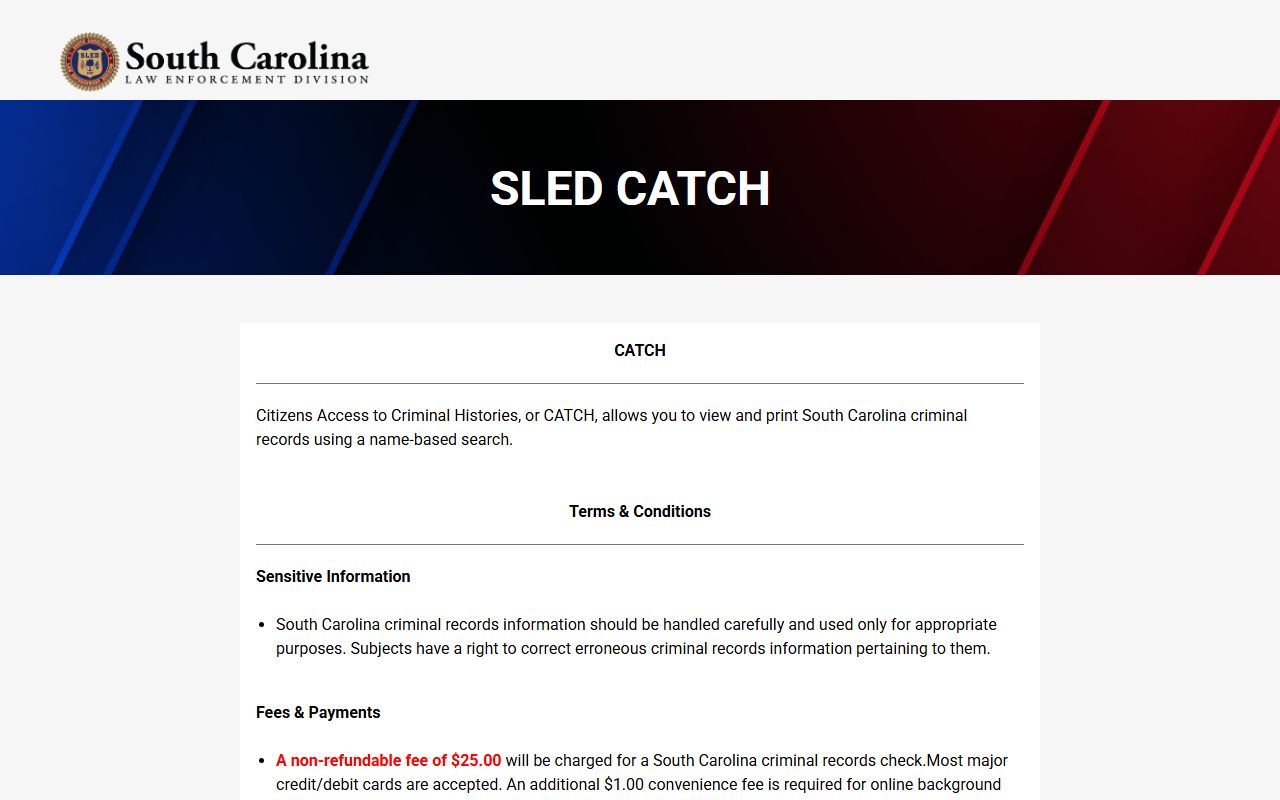
The SLED CATCH portal provides online access to South Carolina criminal records through a convenient name-based search system. This platform represents the primary method for individuals to conduct criminal background checks in the state. The system requires a "starts with" match on the subject's last name, first name, and date of birth to retrieve results. Users can also provide a Social Security Number and maiden name to improve search accuracy. Results are available immediately for most searches. Requesters should ensure they have a working printer to capture their results. Charitable organizations with 501(c)(3) status may qualify for a reduced fee of eight dollars. School districts receive free criminal records checks for prospective teachers and substitute teachers. Each criminal records check costs twenty-five dollars through the CATCH system. An additional one dollar convenience fee applies to all online background searches. Payment is accepted via most major credit and debit cards. Charitable organizations must submit IRS documentation of Section 501(c)(3) status to obtain reduced fee verification. Bona fide churches and registered charitable organizations may also qualify for the reduced fee.
Mail-in requests require payment by business check, certified check, cashier's check, or money order made payable to SLED. Personal checks and cash are not accepted for mail-in requests. Important limitations exist when using CATCH. The system contains South Carolina records only. Wanted persons information is excluded from search results. Sex offender registry data requires a separate search through the SORT system. Name-based searches may produce false positives when aliases are used. Contact the SLED Public Dissemination Unit at 803-896-1443 with questions about search results. The unit operates Monday through Friday between 9am and 4:30pm. Fingerprint-based searches are the most reliable method and least likely to result in false positive or false negative results. SLED only conducts fingerprint-based background checks when required by statute. The results of criminal history record checks must only be reported to SLED and authorized recipients. These results cannot be further disseminated without proper authorization. SLED may submit fingerprints to the FBI's Next Generation Identification system for national checks when authorized by law.
Types of Police Records Available in South Carolina
South Carolina law enforcement agencies maintain various categories of records for public safety documentation. Incident reports form the foundation of police records. These documents detail calls for service, officer observations, and investigative findings. Reports include information about what occurred, when and where it happened, and which individuals were involved. Officers complete incident reports after responding to calls or investigating situations. Most incident reports qualify as public records under South Carolina law, though some information may be redacted for privacy or investigative reasons. The South Carolina Judicial Branch maintains court records that complement arrest information with case disposition details. These court records are accessible through the Public Index system. Accident reports provide essential documentation of vehicle collisions throughout the state. South Carolina law requires reporting accidents involving injury, death, or significant property damage. These reports contain driver identification, vehicle specifications, insurance information, and diagrams depicting the crash scene.
Arrest records document when individuals are taken into custody by law enforcement. These records include booking photographs, fingerprint records, charges filed, and custody status information. Additional available records include warrant information when not confidential, jail and detention center records, and 911 call recordings subject to statutory exemptions. Requesters can obtain accident reports from the agency that investigated the collision. Copies may be subject to fees authorized under the South Carolina Freedom of Information Act. Body-worn camera data is not considered a public record subject to disclosure under state law. SLED, the Attorney General, and circuit solicitors may request and receive such data for legitimate criminal justice purposes. Law enforcement agencies may also access body camera data when relevant to internal investigations regarding misconduct or disciplinary action. The contents of intercepted wire, oral, or electronic communications are exempt from disclosure.
South Carolina Freedom of Information Act
The South Carolina Freedom of Information Act establishes the public's right to access government records. The law declares that public business must be performed openly so citizens can remain informed about official decisions and activities. Under S.C. Code Ann. § 30-4-20, public records include all books, papers, maps, photographs, and documentary materials prepared or retained by public bodies. This broad definition encompasses most police records created during law enforcement operations. Agencies must respond to written FOIA requests within established timeframes. Ten business days are allowed for records less than twenty-four months old. Records exceeding twenty-four months in age receive twenty business days for response. Approved requests must be fulfilled within thirty calendar days. For records more than twenty-four months old, production must occur within thirty-five calendar days.
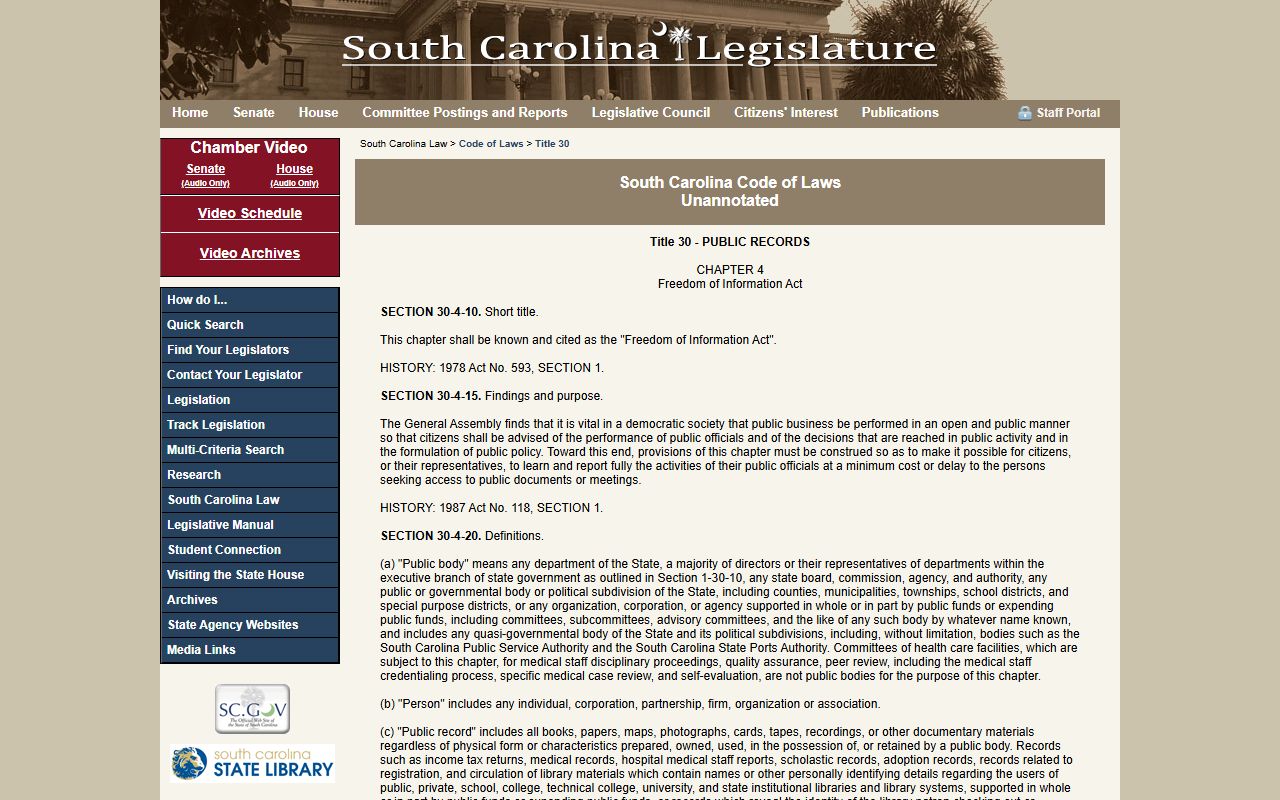
Agencies may charge reasonable fees for searching, retrieving, and copying responsive documents. Certain records remain exempt from disclosure. These include materials that could interfere with prospective law enforcement proceedings. Documents that would deprive persons of fair trials are also protected. Information constituting unreasonable privacy invasions remains confidential. Confidential source identities are protected as well. Current law enforcement techniques and procedures are exempt from production. Records that would endanger individual safety if released may be withheld. The identity of confidential informants receives special protection under the statute. No information contained in a police incident report may be utilized for commercial solicitation purposes. The General Assembly has found that it is vital in a democratic society that public business be performed in an open and public manner so that citizens shall be advised of the performance of public officials.
How to Request Police Records in South Carolina
For statewide criminal history checks, use the SLED CATCH portal for fastest results. Create an account and enter the subject's identifying information. Pay the required fee using a credit or debit card. Print your results directly from the system. Mail-in requests require completing the Criminal Record Check form and including payment by business check, certified check, cashier's check, or money order. Address mail requests to SLED Records Department, P.O. Box 21398, Columbia, SC 29221-1398. Include a self-addressed stamped envelope for document return. Local records require direct contact with the specific police department or sheriff's office. Submit a written request with precise details about the incident. Provide the date, time, and location if known. Include your contact information and valid identification. Be prepared to pay applicable copying fees as authorized by FOIA.
Requesting police records requires understanding the appropriate procedure for your specific needs. The process differs based on which agency maintains the records and what type of documents you seek. Following the correct steps ensures efficient processing of your request. Proper documentation and identification help avoid delays. Some agencies offer online portals for requesting certain record types. Check the agency's website for available options before submitting your request. You do not need to state a purpose when requesting public records in South Carolina. The law permits anyone to submit a request regardless of residency or intended use. Certain records must be made available for public inspection without a written request. These include minutes of meetings for the preceding six months and crime reports for at least the fourteen-day period before the current day. Documents identifying persons confined in any jail or detention center for the preceding three months must also be available.
Finding Police Records by Location
Each of South Carolina's forty-six counties maintains a sheriff's office that serves as the primary law enforcement agency for unincorporated areas. These offices provide comprehensive public safety services including incident documentation, arrest processing, and detention center operations. Sheriff's offices respond to FOIA requests for records within their jurisdictions. They maintain databases of jail inmates, recent arrests, and active warrants when disclosure is permitted. Contact the specific county sheriff's office for records pertaining to unincorporated areas. Municipal police departments serve cities and towns throughout the state with dedicated law enforcement within city limits. These agencies handle patrol operations, criminal investigations, and traffic enforcement in their communities. They maintain separate record systems from county sheriff's offices. City police departments process requests for incidents occurring within municipal boundaries. The South Carolina Judicial Branch provides additional access to court records through the Public Index system, which contains criminal case information from courts statewide.
Browse South Carolina Police Records by County
South Carolina has forty-six counties. Each county sheriff's office maintains police records for their jurisdiction. Select a county below to find local contact information and resources.
Police Records in Major South Carolina Cities
City police departments maintain records for incidents within municipal boundaries. Select a city below to learn about accessing police records in that area.